Steel vs wrought iron gates
Most gates sold as wrought iron today are steel. That affects strength, rust and price, and if you are choosing a gate for a windy desert lot, aluminum belongs in the comparison too.
What wrought iron means now
The name describes a look more than a metal.
 Illustration
True wrought iron is an old, nearly pure iron that smiths hammered and bent into shape. The National Park Service's guide to repairing historic ironwork describes it as soft, tough and "readily worked by forging, bending, and drawing", and notes that mild steel is now what new hand worked metalwork is made from, including repairs to old wrought iron.
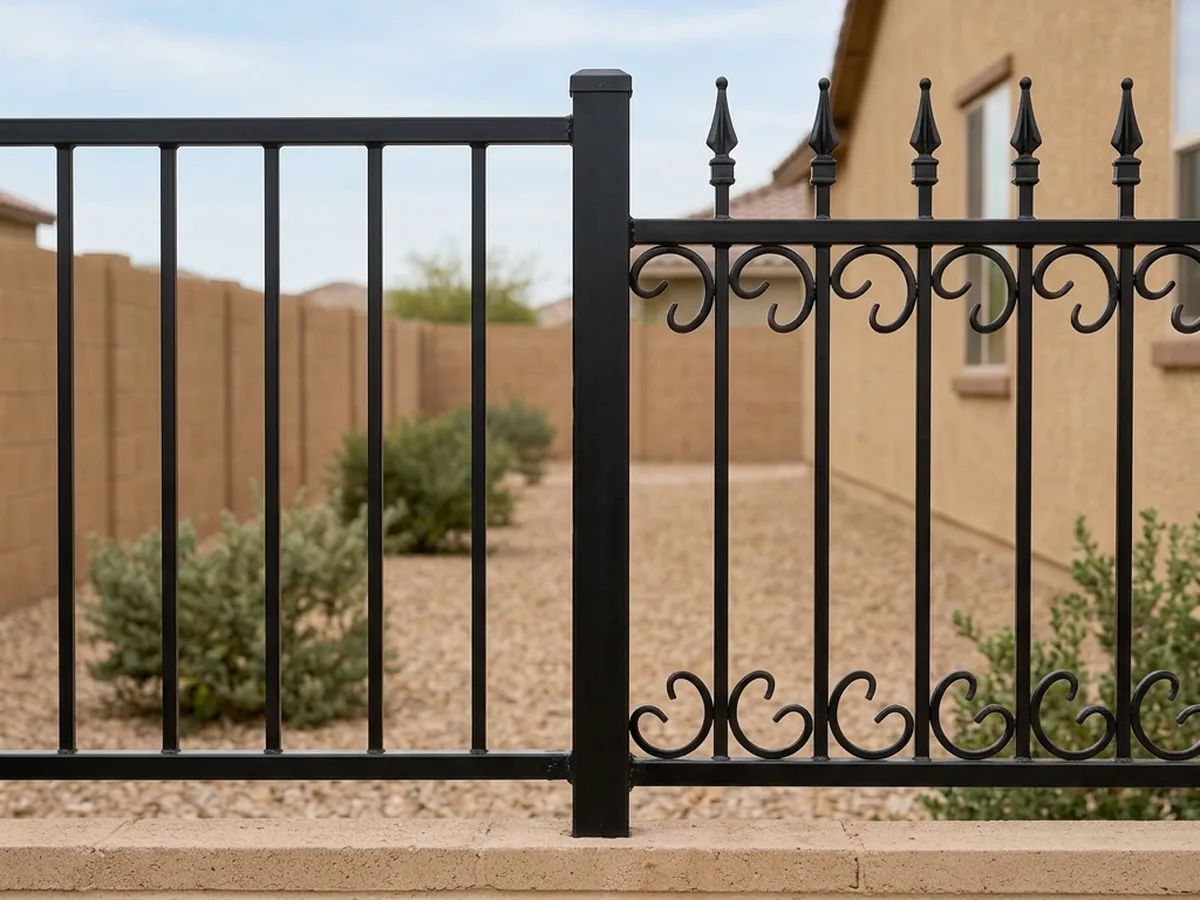
So when a gate is sold as wrought iron, it almost always means welded mild steel shaped in the traditional style: scrolls, twisted pickets, collars and spear tops. A plain steel gate uses the same metal in straight square tube or flat bar. With the wrought iron style, the extra money goes into design and labor. The metal is the same.
Rust and finishes
Steel's one weakness is rust, and the finish is what holds it off.
The same Park Service guide says mild steel "is not as resistant to corrosion as either wrought iron or cast iron," and that iron rusts once relative humidity passes about 65 percent, or lower where soil, salt or other agents sit on the metal. A dry climate slows rust down; sprinkler spray, wet soil against a post and chipped paint speed it back up.
- Paint over primer is the cheapest finish and the easiest to touch up. It needs repainting as it chips.
- Powder coating is baked on and tougher than paint, and it holds color longer in strong sun.
- Galvanizing coats the steel in zinc before any paint goes on. It costs more up front and protects the metal even where the top coat is scratched.
Rust usually starts at the welds, the bottom rail and the base of the posts, where water sits longest. Checking those spots each spring catches most of it early. If it is already through the metal, see metal gate repair.
Weight and wind
In Lancaster the wind decides as much as the metal does.
Steel
Heavy and stiff, which is what a wide leaf needs to stay square. The weight goes into the hinges and the hinge post, so both have to be sized for it.
Wrought iron style
The same steel with more metal in the scrolls and twists. That makes it a little heavier, and it gives the wind a little more solid area to push on.
Aluminum
Light and rust free, easy on hinges and on an opener. It dents more easily, and it costs more for the same size of gate.
NOAA's Fox Field records show 51 days with gusts of 40 mph or more in Lancaster in 2024, peaking at 61 mph. Whatever the metal, open pickets let that wind through, and a solid panel catches all of it. A solid steel gate here needs heavier posts than an open one.
Which one to pick
National cost guides list manual steel and wrought iron driveway gates at the same $600 to $4,000 before installation, and aluminum at $1,800 to $4,100.
Every gate price rangePlain steel suits a wide or tall gate that has to stay square in the wind and be easy to repair. If the look matters and you don't mind paying for the extra metalwork, go with wrought iron style. Aluminum makes sense when weight matters most, say a long leaf on an opener, and dents are unlikely.
For widths, swing or slide and what each costs, see driveway gates in Lancaster. To have a licensed installer price the gate you have in mind, start with installing a steel gate in Lancaster.
Get a price on the gate you picked
Tell us the metal, the style and the opening width. A licensed installer follows up with a free written quote and no pressure to sign.